
Skin
NHEK/SVTERT3-5
NHEK/SVTERT3-5 cells show an extended in vitro life span and express typical functions of skin keratinocytes as they can be differentiated towards 3D skin equivalents in an air-liquid interface. Thus, the cell line can be used as standardized in vitro model to study processes such as wound healing or to investigate the uptake of certain drugs. Additionally, due to its unique characteristics, the cell line allows studying chronic intoxication as demonstrated using arsenic.
General information
Cat#: CLHT-011-0026-5
Morphology and 3D differentiation
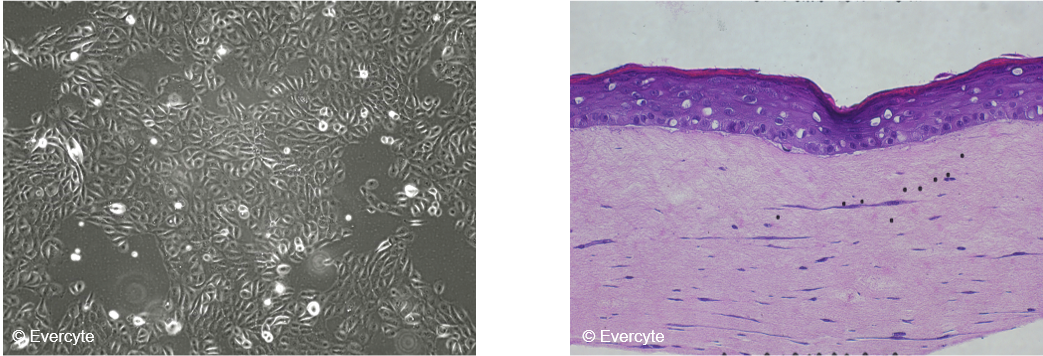
NHEK/SVTERT3-5 cells show the typical cobblestone epithelial morphology of keratinocytes and can be differentiated towards a stratified skin equivalent in an air-liquid interface.
In vitro propagation
Keratinocyte growth medium KGM Gold + G418
KBM Gold basal medium (Lonza, Cat# 00192151)
Components of KGM Gold SingleQuot Kit (Lonza, Cat# 00192152: BPE, hEGF, insulin, hydrocortisone, transferrin, epinephrine)
Additional material & reagents
Phosphate buffered saline (PBS) (Sigma, Cat# D8537)
Trypsin inhibitor (Gibco, Cat# R007100)
0,05 % Trypsin-EDTA (Gibco, Cat#25300-054)
EASY cell strainer (Greiner, Cat# 542000)
Passaging of cells
For detachment of the cells remove and discard the culture medium and wash the cells once with PBS (about 160 µl/cm²). Remove PBS completely.
Cryopreservation
Freezing medium
Additional material & reagents
0,05 % Trypsin-EDTA (Gibco, Cat# 25300-054)
Trypsin inhibitor (Gibco, Cat# R007100)
Freezing of cells
Detach the cells (60-70 % confluence) from the culture vessel by using Trypsin-EDTA and Trypsin-Inhibitor (Protocol passaging of NHEK/SVTERT3-5).
Thawing of cells
Original Evercyte cells are to be thawed in a T25 rouxflask
Product data sheet – certificate of analysis
Protocols
Data on Markers and Functions
Publications
Hakoi H, Miki Y, Nomura S, Nakajima K, Terashima-Murase C, Takeichi T, Sano S, Akiyama M, Sakasegawa SI, Murakami M, Yamamoto K. Lysophospholipase D from Thermocrispum limits psoriatic inflammation by hydrolyzing epidermal lysoplasmalogen produced by group IIF secreted phospholipase A2. Biochimie. 2023 Dec;215:75-87. doi: 10.1016/j.biochi.2023.09.027.
Ota A, Morita H, Naganuma T, Miyamoto M, Jojima K, Nojiri K, Matsuda J, Kihara A. Bifunctional DEGS2 has higher hydroxylase activity toward substrates with very-long-chain fatty acids in the production of phytosphingosine ceramides. J Biol Chem. 2023 Apr;299(4):104603. doi: 10.1016/j.jbc.2023.104603. Epub 2023 Mar 11.
Wei Z, Liu X, Ooka M, Zhang L, Song MJ, Huang R, Kleinstreuer NC, Simeonov A, Xia M, Ferrer M. Two-Dimensional Cellular and Three-Dimensional Bio-Printed Skin Models to Screen Topical-Use Compounds for Irritation Potential. Front Bioeng Biotechnol. 2020 Feb 21;8:109. doi: 10.3389/fbioe.2020.00109.
Weinmuellner R, Kryeziu K, Zbiral B, Tav K, Schoenhacker-Alte B, Groza D, Wimmer L, Schosserer M, Nagelreiter F, Rösinger S, Mildner M, Tschachler E, Grusch M, Grillari J, Heffeter P. Long-term exposure of immortalized keratinocytes to arsenic induces EMT, impairs differentiation in organotypic skin models and mimics aspects of human skin derangements. Arch Toxicol. 2018 Jan;92(1):181-194. https://pubmed.ncbi.nlm.nih.gov/28776197/
Wagner T, Gschwandtner M, Strajeriu A, Elbe-Bürger A, Grillari J, Grillari-Voglauer R, Greiner G, Golabi B, Tschachler E, Mildner M. Establishment of keratinocyte cell lines from human hair follicles. Sci Rep. 2018 Sep 7;8(1):13434. https://pubmed.ncbi.nlm.nih.gov/30194332/
Licence Conditions
The business concept of Evercyte is to out-license telomerized cells to our customers. The license conditions depend on whether the contract partner is a for profit or a nonprofit organization and the intended use of the cells.
Nonprofit organizations
On time payment for unlimited use: EUR 1900
Profit organizations
Pharmaceutical – chemical- cosmetic industries
Contract research organizations (CRO)
Initial license fee for 3 months: EUR 2700Annual license fee R&D: royalty based